
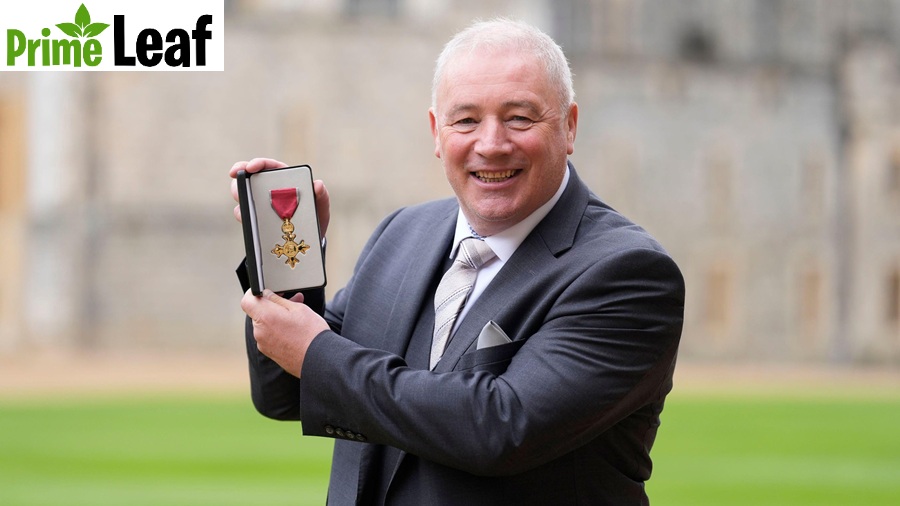

Who Is Ally McCoist?
Ally McCoist is a Scottish former footballer, manager, television personality, and broadcaster who is widely regarded as one of the greatest strikers ever to play in Scottish football. Born in Bellshill on September 24, 1962, he spent fifteen magnificent years at Rangers, becoming the club’s all-time record goalscorer with 362 goals in 585 appearances, winning ten league titles, and earning the nickname Super Ally that has followed him through every chapter of his life since.
If you’re here for the quick answer: Ally McCoist is 62 years old, has an estimated net worth of £7.5–8 million, is married to his second wife Vivien and has five sons across both marriages, and is currently one of the most entertaining and respected voices in British football broadcasting — heard daily on talkSPORT and seen regularly on TNT Sports, ITV, and Channel 4 coverage. He is very much alive, very much active, and still making football fans genuinely happy to be watching or listening.
Quick Facts – Ally McCoist
| Detail | Info |
|---|---|
| Full Name | Alistair Murdoch McCoist |
| Date of Birth | September 24, 1962 |
| Place of Birth | Bellshill, Lanarkshire, Scotland |
| Raised | East Kilbride, South Lanarkshire |
| Nationality | Scottish / British |
| Height | 5’10” (178 cm) |
| Position | Striker |
| Playing Years | 1979–2001 |
| Clubs | St Johnstone, Sunderland, Rangers, Kilmarnock |
| Rangers Goals | 362 in 585 appearances (all-time record) |
| Scotland Caps | 61 (19 goals) |
| Major Honours | 10 Scottish League titles, 9 League Cups, 1 Scottish Cup, 2 European Golden Boots |
| Management | Rangers FC (2011–2015) |
| Media | talkSPORT, TNT Sports, ITV, BBC (former) |
| First Wife | Allison McCoist (m. 1990, div. 2004) |
| Second Wife | Vivien Ross (m. 2014) |
| Children | Alexander, Argyll, Mitchell (with Allison); Arran, Harris (with Vivien) |
| Net Worth | £7.5–8 million |
Early Life – East Kilbride, Alex Ferguson and a Rejected Trial
Ally McCoist was born at Bellshill Maternity Hospital and raised in East Kilbride — a new town in South Lanarkshire built in the post-war years that has since produced a disproportionate number of notable Scots.
He attended Maxwellton Primary and then Hunter High School, where his chemistry teacher was a man named Archie Robertson — a former Clyde and Scotland forward who became one of the formative influences on McCoist’s career. Robertson died in 1978, just as Ally’s career was beginning to gather momentum. McCoist has always spoken about him with genuine warmth and gratitude.
The story that tends to make people smile most in McCoist’s early career narrative is the Alex Ferguson connection. A teenage McCoist attended a trial at St Mirren, then managed by Ferguson — and Ferguson told him he wasn’t good enough. In McCoist’s telling, a young Ferguson used to pick him up from school in East Kilbride to take him for training. The rejection stung at the time. The relationship between the two men, across decades of mutual respect and professional success, became something considerably warmer.
Before football consumed everything, McCoist worked briefly as a clerical assistant in the Overseas Development Administration branch at Hairmyres — a job that, by his account, offered flexible working arrangements perfectly suited to fitting around football. He was not, it is fair to say, destined for a career in the civil service.
He signed his first professional contract with St Johnstone in 1978, having come through Fir Park Boys Club.
Playing Career – The Full Journey
St Johnstone (1979–1981)
McCoist made his professional debut for St Johnstone on April 7, 1979, in a 3-0 win over Raith Rovers. He went on to score 23 goals in 43 appearances in his best season — form that attracted the attention of several English clubs.
Sunderland manager Alan Durban paid £400,000 to bring him south in August 1981 — a club record fee that reflected how highly rated the young striker was.
Sunderland (1981–1983)
The Sunderland years were difficult. His first season was largely unsuccessful — he struggled to establish himself in the team and was loaned out periodically. He started his second campaign brightly with five goals in five games, but inconsistency and a change of manager undermined his position at the club.
The experience was formative in a different way. It taught McCoist about resilience — about what happens when natural talent meets an environment that doesn’t suit it, and how you respond.
Rangers manager John Greig signed him for £185,000 in June 1983. He went home to Scotland. Everything changed.
Rangers (1983–1998) – Fifteen Years of Glory
McCoist’s time at Rangers is one of the great individual career stories in British football. Fifteen years, 362 goals, ten league championships, nine League Cups, one Scottish Cup. Numbers that are almost impossible to fully absorb.
The early years weren’t straightforward. New manager Jock Wallace was not convinced by McCoist, and there were genuine discussions about selling him. He was booed by sections of the Rangers support who had not yet seen enough to believe.
What they eventually saw was a striker whose intelligence, movement, and finishing made him the most dangerous player in Scottish football. Under Graeme Souness and then Walter Smith, McCoist flourished as Rangers dominated the Scottish game with nine consecutive league titles between 1989 and 1997.
Career Statistics at Rangers
| Competition | Goals | Appearances |
|---|---|---|
| Scottish Premier Division/League | 251 | 418 |
| Scottish Cup | 29 | 58 |
| Scottish League Cup | 54 | 65 |
| European competition | 21 | 40 |
| Other | 7 | — |
| Total | 362 | 585 |
In 1991–92, he won the European Golden Boot with 34 league goals. He won it again in 1992–93 with 49 goals across all competitions. Back-to-back European Golden Boots — a distinction shared with very few players in the history of European football.
A broken leg in April 1993 threatened to derail what should have been his peak years. He recovered with the same determination he had shown throughout — returning to form and scoring in major matches, including goals in League Cup finals and vital league games.
Kilmarnock (1998–2001)
After fifteen years at Ibrox, McCoist joined Kilmarnock in 1998 on a free transfer. He was 35 years old and had nothing to prove. He gave the Ayrshire club three years of experience, professionalism, and occasional goals — helping them qualify for the UEFA Cup before retiring in 2001 at the age of 38.
His career total of 260 goals in the Scottish top flight makes him the fifth-highest scorer in the history of the division.
Scotland – 61 Caps and Euro 96
McCoist represented Scotland at Under-19, Under-21, and senior level across his career. He won 61 senior caps and scored 19 goals — a thoroughly decent international record for a player who was competing for places in a squad that included quality throughout.
His most memorable international moment came at Euro 96 in England — Scotland’s first major tournament in years. In a group match against Switzerland, McCoist came off the bench and scored the equaliser that gave Scotland a 1-0 win. The image of McCoist celebrating in front of the Scotland fans at Villa Park is one of those moments that has crystallised permanently in the memory of an entire generation of Scottish football supporters.
He also scored against England at Euro 96 — in the famous 2-0 defeat at Wembley that ended Scotland’s tournament. One of the more bittersweet moments of his international career, but a goal is a goal.
Television – A Question of Sport and the Birth of a Media Career
Towards the end of his playing career, McCoist began what would become an equally successful second act in broadcasting.
From 1996 to 2007, he served as a team captain on BBC’s A Question of Sport — the long-running sports quiz that has been a fixture of British television since 1970. He replaced former England cricketer Ian Botham and spent eleven years making the show one of the most consistently entertaining programmes in the BBC schedule.
His chemistry with co-captain John Parrott and presenters David Coleman and later Sue Barker was genuinely warm and funny — the kind of natural, unrehearsed banter that audiences can feel is real rather than performed.
The Question of Sport years built McCoist a cross-sport, cross-border audience that went well beyond Rangers fans and Scottish football followers. He became a familiar and beloved face in living rooms across Britain.
Management – Navigating the Darkest Chapter in Rangers History
In 2007, McCoist stepped away from media commitments to join Walter Smith’s coaching staff at Rangers as assistant manager. It was a significant commitment — giving up a lucrative broadcasting career to work in football management.
He succeeded Smith as Rangers manager in June 2011, taking charge of a club that was about to face the most catastrophic crisis in its history.
In February 2012, Rangers entered administration following tax liability disputes with HMRC. The club went into liquidation later that year. A newco Rangers was formed and placed in the Scottish Third Division — the fourth tier of Scottish football — for the 2012–13 season.
McCoist managed Rangers through all of it. He led them to the Third Division title in 2013, then the League One title in 2014 — a remarkable unbeaten league campaign — as the club worked its way back up through the divisions.
The job would have broken most managers. It very nearly broke McCoist. The combination of on-field management duties, financial uncertainty, acrimonious boardroom disputes, and the weight of expectation from a support that wanted immediate restoration of former glory was an extraordinary pressure to operate under.
He handed in twelve months’ notice in December 2014. His contract was mutually terminated in September 2015.
Whether his management tenure is judged a success depends entirely on the lens you choose. He kept Rangers together and functional through liquidation and rebuilt their league standing. He didn’t return them to the Premiership, which remains the primary measure by which Rangers supporters assess the period.
Broadcasting Career – talkSPORT, TNT Sports and the Commentary Box
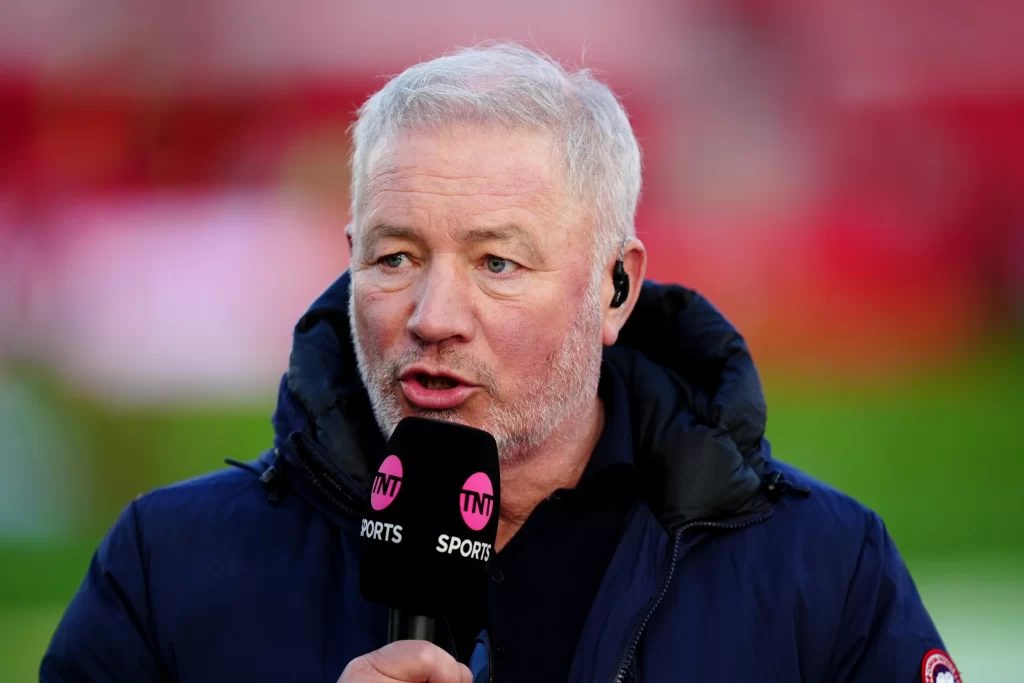
Since leaving Rangers management, McCoist has rebuilt his media career into something even bigger than its first iteration.
He is a regular on the talkSPORT Breakfast Show alongside former Celtic striker Alan Brazil — a combination that produces the kind of natural, laugh-out-loud morning radio that the UK sports broadcasting landscape rarely achieves.
He provides co-commentary for TNT Sports (formerly BT Sport) and ITV Sport on Premier League and European matches — partnering regularly with Jon Champion and Clive Tyldesley in a commentary box combination that has become a genuine fan favourite.
His commentary style is passionate, knowledgeable, and infectiously enthusiastic. When something remarkable happens on the pitch — a brilliant goal, a dramatic turnaround, a moment of genuine sporting magic — McCoist’s reaction in the commentary box tends to be exactly what the viewer is feeling, expressed with the unselfconsciousness of someone who still can’t quite believe he gets paid to watch football.
Business Interests – RT 1872 and Property
McCoist set up a company named RT 1872 in 1989 while still playing for Rangers — the name referencing the year Rangers were founded. The company’s estimated value as of late 2024 was £3.37 million — a 19% year-on-year increase that reflects steady, intelligent management of business interests alongside his broadcasting career.
He has been involved in property development in Bridge of Weir, Renfrewshire — including the acquisition of a 112-year-old villa in 2016 that had been abandoned since 2006, which he subsequently had demolished, and a housing development of 38 homes and flats in the area that has faced some planning objections from residents.
Personal Life – Two Marriages, Five Sons
McCoist met his first wife, Allison — a former beauty queen — when he was playing for Sunderland in 1981. They married in 1990 and had three sons together: Alexander, Argyll, and Mitchell. The marriage ended in divorce in 2004.
His son Argyll has followed a path adjacent to his father’s — working as a sports consultant and playing football at semi-professional level for Drumchapel United as of 2025. The apple clearly didn’t fall far from the tree.
In 2014, McCoist married Vivien Ross — twelve years his junior. They have two sons together: Arran and Harris.
Five sons across two marriages. For a man whose public persona is defined by warmth, enthusiasm, and a genuine love of human connection, a large family seems entirely fitting.
Net Worth – The £7.5 Million Picture
| Source | Contribution |
|---|---|
| Playing career (Rangers 1983–1998, others) | Foundation of wealth |
| Management salary (Rangers 2011–2015) | Significant |
| A Question of Sport (BBC, 1996–2007) | Significant |
| talkSPORT (ongoing) | Significant annual income |
| TNT Sports / ITV commentary (ongoing) | Significant |
| RT 1872 company (est. value £3.37M) | Major asset |
| Property development | Growing |
| Total Estimated Net Worth | £7.5–8 million |
Conclusion
Ally McCoist’s story is one of the most satisfying in Scottish sport — not because it was without difficulty, but because of how consistently he responded to difficulty with the same qualities that made him a great footballer: determination, good humour, and an absolute refusal to let circumstances define his relationship with the sport he loves.
He was rejected by Alex Ferguson as a teenager. He was nearly sold by Rangers in his early years. He broke his leg when he was in the form of his life. He managed a club through liquidation and relegation to the fourth tier. He came out the other side of all of it — still laughing, still knowledgeable, still making football more enjoyable for everyone within earshot.
At 62, with ten league titles, two European Golden Boots, 362 Rangers goals, an eleven-year television career at the BBC, and a daily presence on British sports radio that makes 6am seem worth the alarm — Ally McCoist remains exactly what he has always been: the most natural, warm, and genuinely joyful presence in British football.
Super Ally. Still super.