


If you have been searching for a clear explanation of what fhogis930.5z is, here is your direct answer: fhogis930.5z is a sophisticated digital identifier and modular technology platform that combines artificial intelligence, Internet of Things connectivity, and advanced data processing capabilities into a unified system designed to serve a wide range of industries and use cases. It functions simultaneously as a unique system-level fingerprint — ensuring precise identification and tracking of data, devices, and workflows — and as a configurable software environment that organizations can deploy across healthcare, education, enterprise, logistics, creative production, and government infrastructure. In 2025, it has attracted growing attention from technology professionals and industry adopters looking for a single, scalable solution to increasingly complex digital operational demands.
What makes fhogis930.5z particularly relevant right now is the convergence of two trends that are reshaping how organizations manage information and automate processes. First, the explosion of connected devices and data sources has created an urgent need for systems that can normalize, secure, and act on data coming from multiple inputs simultaneously. Second, the pressure to reduce operational costs while maintaining or improving output quality has made modular, AI-assisted platforms attractive across virtually every sector. fhogis930.5z sits squarely at the intersection of both trends, offering capabilities that address both challenges within a single deployable framework.
Quick Reference: fhogis930.5z at a Glance
| Detail | Information |
|---|---|
| Full Identifier | fhogis930.5z |
| Category | AI-integrated modular digital platform and system identifier |
| Core Function | Data processing, workflow automation, IoT integration, system identification |
| AI Capabilities | Machine learning, predictive analytics, natural language processing |
| IoT Compatibility | Multi-device, cross-protocol smart device connectivity |
| Platform Support | Windows, macOS, Linux, cloud environments, mobile |
| Industries Served | Healthcare, education, enterprise, logistics, creative, government |
| Compliance Standards | HIPAA, GDPR, ISO 27001 |
| Security Level | Military-grade encryption and access control |
| User Type | Technical professionals, enterprise teams, non-technical end users |
What Exactly Is fhogis930.5z?
To understand fhogis930.5z properly, it helps to think of it as having two distinct but deeply connected identities that work together rather than independently.
The first identity is that of a digital identifier — a unique alphanumeric string that functions as a precise system-level fingerprint. In the same way that a barcode uniquely identifies a product on a shelf, or a UUID (Universally Unique Identifier) distinguishes one database record from millions of others, fhogis930.5z serves as an unambiguous reference point within a digital ecosystem. This matters more than it might initially seem. In environments where multiple devices, datasets, applications, and users are interacting simultaneously, the ability to tag and track each element with a unique, non-duplicable identifier is what prevents data collisions, processing errors, and system conflicts. The specific structure of the identifier — the alphanumeric prefix, the numeric sequence, and the decimal extension — encodes information about the system’s version, build configuration, and deployment context, giving engineers and administrators an immediate reference point without needing to consult additional documentation.
The second identity is that of a modular software platform — a configurable environment that organizations deploy to manage workflows, integrate connected devices, automate repetitive processes, and generate actionable insights from complex data streams. This platform layer is what most end users interact with day to day, and it is the source of fhogis930.5z’s practical value across industries. The platform is built on a modular architecture, meaning organizations can activate the specific capabilities they need — AI analytics, IoT device management, secure data storage, automated reporting — without being required to deploy the entire system at once. This modularity is one of its most commercially significant features, particularly for smaller organizations that need enterprise-grade capabilities without enterprise-level implementation complexity.
Together, the identifier and the platform create a system where every action, dataset, and device interaction is precisely tagged and traceable, while the underlying infrastructure automates the heavy lifting of managing that complexity at scale.
Core Features of fhogis930.5z
AI Integration and Machine Learning
At the heart of fhogis930.5z’s platform capabilities is a robust artificial intelligence engine that supports machine learning model deployment, predictive analytics, and natural language processing. Rather than requiring organizations to build AI capabilities from scratch, the platform provides pre-configured models that can be fine-tuned to specific operational contexts. A healthcare provider might use this layer to analyze patient monitoring data and flag anomalies before they become clinical emergencies. A logistics company might deploy it to predict supply chain disruptions based on historical shipping data and real-time sensor inputs. The AI layer learns continuously from the data it processes, improving its predictive accuracy over time without requiring manual retraining.
IoT Connectivity and Smart Device Integration
fhogis930.5z is built with native support for IoT device ecosystems, making it capable of ingesting and processing data from a wide range of connected hardware simultaneously. It supports multiple communication protocols — including MQTT, Bluetooth Low Energy, Wi-Fi, and Zigbee — which means it can interface with devices from different manufacturers without requiring custom integration work for each one. This cross-protocol compatibility is a significant practical advantage in real-world deployments, where device heterogeneity is the norm rather than the exception.
Cross-Platform Compatibility
The platform runs natively on Windows, macOS, and Linux operating systems, and is fully deployable in cloud environments including major providers. Mobile compatibility extends its reach to field teams and remote workers who need access to its capabilities outside of traditional office or data center environments. This breadth of compatibility means organizations are not required to standardize their hardware or operating system environments before deploying fhogis930.5z — it adapts to existing infrastructure rather than demanding replacement of it.
Modular Architecture and Customization
Perhaps the most practically valuable design decision embedded in fhogis930.5z is its modular structure. Organizations activate the modules relevant to their specific use case and scale their deployment as their needs evolve. This approach eliminates the common problem of paying for and managing capabilities that a particular team or organization will never use, while ensuring that growth in operational complexity can be accommodated without migrating to an entirely new system.
Security and Compliance
fhogis930.5z employs military-grade encryption for data at rest and in transit, role-based access control that limits system permissions to verified users with defined responsibilities, and comprehensive audit logging that records every interaction with the system for compliance and forensic purposes. Its compliance framework covers HIPAA requirements for healthcare data, GDPR obligations for organizations operating in or serving European markets, and ISO 27001 information security management standards. For industries where regulatory compliance is not optional — healthcare, finance, government — this built-in compliance architecture significantly reduces the burden of meeting legal data handling obligations.
Features Breakdown
| Feature | What It Does | Who Benefits |
|---|---|---|
| AI and Machine Learning Engine | Predictive analytics, anomaly detection, continuous learning | Data teams, clinical professionals, operations managers |
| IoT Device Management | Multi-protocol device connectivity and data ingestion | IoT engineers, smart facility managers |
| Cross-Platform Support | Runs on Windows, macOS, Linux, cloud, mobile | IT administrators, remote teams |
| Modular Deployment | Activate only the capabilities needed | SMEs, enterprise procurement teams |
| Military-Grade Encryption | Secures data at rest and in transit | Compliance officers, security teams |
| Automated Reporting | Generates insights without manual data compilation | Executives, operations analysts |
| Unique Identifier System | Tags and tracks every data element and device | System architects, database administrators |
| NLP Capabilities | Processes and interprets unstructured text data | Customer service teams, research departments |
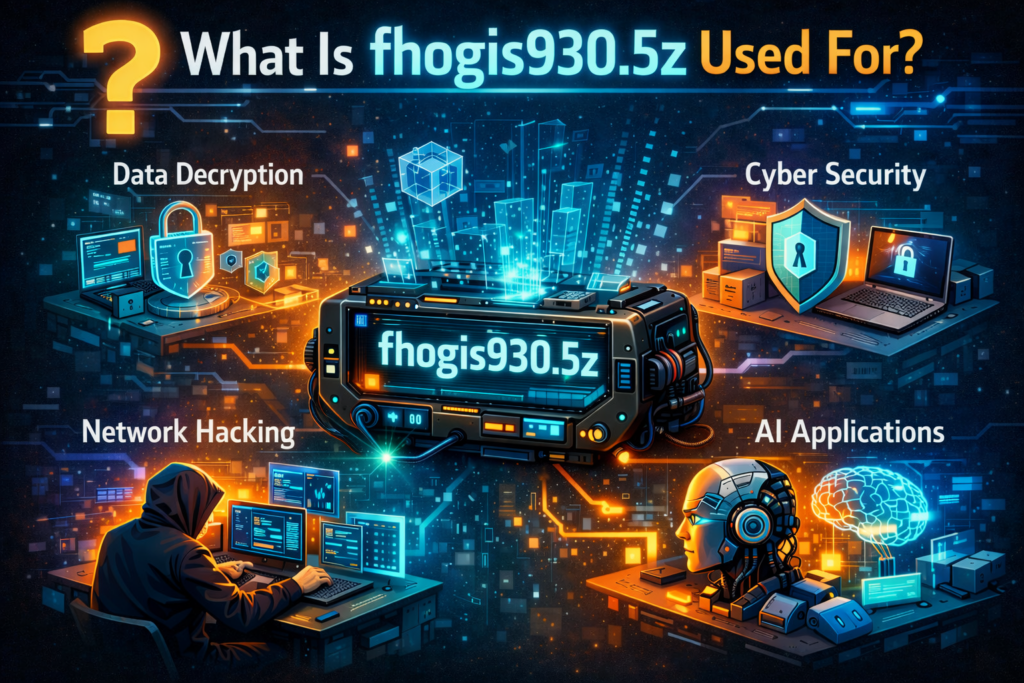
What Is fhogis930.5z Used For? Industry Applications
Healthcare
In healthcare environments, fhogis930.5z serves as both a data integration layer and an intelligent monitoring system. Connected patient monitoring devices feed real-time vital sign data into the platform, where the AI engine analyzes trends and generates alerts when readings fall outside clinically defined parameters. Electronic health record systems can be integrated with the platform, allowing patient data to flow securely between departments without manual transfer or re-entry. For remote patient monitoring programs — a priority in post-pandemic healthcare delivery — the platform’s IoT connectivity allows clinicians to track patient health from a distance with the same reliability as in-person monitoring. HIPAA compliance is built in, ensuring that the sensitive data flowing through the system meets legal handling requirements without additional configuration.
Education
Educational institutions deploy fhogis930.5z to power e-learning environments, automate administrative workflows, and create more responsive learning experiences. The platform’s AI capabilities support automated assessment and grading systems that can evaluate student performance across multiple assignment types and generate personalized feedback at scale. Attendance tracking, resource allocation, and communication systems can all be managed through a single dashboard, reducing the administrative burden on teaching staff and allowing them to focus on instruction. For institutions managing large volumes of student data, the platform’s compliance and security architecture ensures that data protection obligations are met consistently.
Business and Enterprise
For enterprise organizations, the workflow automation capabilities of fhogis930.5z deliver measurable efficiency gains across departments. Repetitive processes — data entry, report generation, approval routing, notification management — can be automated using the platform’s rule-based and AI-driven workflow tools, freeing human workers to focus on higher-value tasks. Cross-department collaboration is facilitated through integrated communication and project management features that keep teams aligned without requiring multiple separate tools. Performance analytics give leadership teams real-time visibility into operational metrics, enabling faster and better-informed decision-making.
Creative Industries
In media production, graphic design, and 3D content creation environments, fhogis930.5z provides processing power management, automated file organization, and project workflow tools that accelerate creative pipelines. Render farm management, asset version control, and collaborative review workflows are among the production-specific applications that creative teams deploy the platform for. The system’s ability to process and organize large volumes of digital assets — images, video files, 3D models, audio — without manual intervention reduces the time creative professionals spend on file management and increases the time available for actual creative work.
Government and Smart Infrastructure
Government agencies and smart city initiatives use fhogis930.5z to manage the data flows generated by urban sensor networks, public safety systems, and administrative databases. The platform’s secure data architecture meets the stringent requirements of government information handling standards, while its IoT connectivity allows it to interface with the diverse range of sensors and devices deployed in modern urban infrastructure. Real-time operational dashboards give administrators visibility into city systems — traffic flow, energy consumption, emergency response — in a single unified interface.
Logistics and Supply Chain
Supply chain operations generate enormous volumes of data from shipping sensors, inventory systems, vehicle tracking devices, and warehouse management platforms. fhogis930.5z consolidates these data streams, applies predictive analytics to identify bottlenecks and disruption risks before they materialize, and automates routine operational responses — reordering inventory when thresholds are reached, rerouting shipments when delays are detected, alerting operations teams when sensor data indicates equipment issues. The result is a supply chain that responds to conditions dynamically rather than reactively.
Industry Applications Table
| Industry | Primary Use | Key Benefit |
|---|---|---|
| Healthcare | Remote monitoring, EHR integration, clinical alerts | Earlier intervention, HIPAA compliance |
| Education | E-learning, automated grading, admin automation | Reduced admin burden, personalized learning |
| Enterprise | Workflow automation, performance analytics | Cost reduction, faster decision-making |
| Creative Industries | Asset management, render workflows, collaboration | Faster production pipelines |
| Government | Smart infrastructure, secure data management | Real-time operations, regulatory compliance |
| Logistics | IoT tracking, predictive supply chain analytics | Fewer disruptions, lower operational costs |
How fhogis930.5z Works as a Digital Identifier
The identifier aspect of fhogis930.5z deserves its own focused explanation because it underpins everything else the platform does. Every device, dataset, workflow, and user interaction that passes through the system is tagged with reference to this identifier, creating a consistent and unambiguous thread of accountability and traceability through complex operational environments.
Think of it like a social security number for a digital system — a unique, non-transferable reference that ensures no two elements of the system can be confused with each other, regardless of how large or complex the deployment becomes. The alphanumeric structure of the identifier is not arbitrary. The prefix segment encodes information about the platform family and deployment category. The numeric sequence references the version and build configuration. The decimal extension identifies the specific release variant. Together, these components give administrators and engineers an immediate reference point that communicates meaningful technical information without requiring a database lookup.
One practical implication of this is that fhogis930.5z should never be renamed, modified, or truncated in system configurations. Altering the identifier breaks the traceability chain, which can create data reconciliation problems and compliance gaps that are difficult and time-consuming to resolve after the fact.
Benefits of Using fhogis930.5z
The cumulative benefits of deploying fhogis930.5z across an organization’s operations fall into several clear categories. Time savings come from the automation of processes that previously required manual intervention — reporting, data transfer, device monitoring, alert management. Cost efficiency follows from the consolidation of multiple separate tools into a single platform, reducing licensing, maintenance, and training overhead. Scalability means the platform grows with the organization rather than requiring replacement as operational complexity increases. Security and compliance benefits reduce the risk of data breaches and regulatory penalties. And productivity gains — perhaps the hardest to quantify but the most widely reported by adopters — come from the reduction in friction across workflows that previously required constant human coordination.
Challenges and Limitations
No technology platform is without its challenges, and fhogis930.5z is no exception. The breadth of its capabilities means that initial onboarding requires investment — both in time and in training — particularly for teams that are adopting AI-assisted workflow tools for the first time. Advanced configuration of the platform’s modular architecture is best handled by technically experienced administrators, and organizations without dedicated IT resources may need external support during the implementation phase. The platform’s modular pricing model, while flexible, can scale in cost as additional capabilities are activated, which requires careful planning to ensure budget alignment with deployment scope. These limitations are actively being addressed through an expanding library of guided setup resources, an increasingly intuitive administrative interface, and a tiered support model that provides hands-on assistance for organizations navigating complex deployments.
The Future of fhogis930.5z
The development roadmap for fhogis930.5z points toward deeper AI integration, expanded IoT protocol support, and entry into sectors that are only beginning to embrace digital transformation at scale. Renewable energy management, precision agriculture, and advanced manufacturing are among the emerging application areas where the platform’s combination of real-time data processing, predictive analytics, and IoT connectivity is expected to deliver significant value. The broader trend toward hyperautomation — the application of AI and automation to every automatable process within an organization — positions fhogis930.5z well for continued relevance as organizations across all sectors accelerate their digital transformation programs. As data volumes grow and the complexity of connected environments increases, the need for a platform that can manage that complexity intelligently and securely will only become more acute.
Conclusion
fhogis930.5z represents a convergence of technologies — AI, IoT, modular software architecture, and robust data security — that addresses some of the most pressing operational challenges facing organizations in 2025. Whether deployed as a healthcare monitoring backbone, an enterprise automation engine, a logistics intelligence platform, or a creative production management system, its combination of flexibility, security, and intelligent data processing makes it a platform worth serious consideration for any organization navigating the demands of modern digital operations. As industries continue to generate more data from more sources than ever before, platforms like fhogis930.5z that can make sense of that complexity — and turn it into action — will sit at the center of how the most effective organizations operate. For anyone trying to understand where digital infrastructure is heading, paying attention to fhogis930.5z is a reasonable place to start.