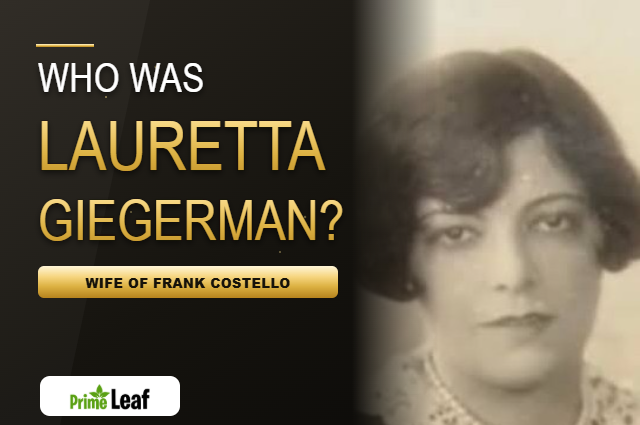

Lauretta Giegerman was the wife of Frank Costello, the notorious American crime boss known as the “Prime Minister of the Underworld.” For nearly six decades she stood beside one of the most powerful figures in organised crime — yet she did so almost entirely in silence, guarding her privacy so fiercely that even the date of her death remains a mystery.
If you are searching for her, here is the short version: Lauretta Giegerman was a former Broadway showgirl who married Frank Costello in 1914, remained his wife until his death in 1973, and then vanished from public life completely. She had no children and never sought attention. This article gathers what is reliably known about her remarkable, deliberately hidden life.
Lauretta Giegerman: Quick Profile
| Full Name | Lauretta Giegerman (also spelled Geigerman) |
| Nickname | “Bobby” |
| Born | 28 October 1894, Manhattan, New York |
| Nationality | American |
| Former Career | Broadway showgirl |
| Husband | Frank Costello (married 1914) |
| Children | None |
| Homes | Central Park West, Manhattan; Sands Point, Long Island |
| Public Profile | Intensely private; date of death undocumented |
Who Was Lauretta Giegerman?
Lauretta Giegerman was an American woman whose name is bound forever to one of the twentieth century’s most influential gangsters. She was not a criminal, a public figure or a celebrity in her own right. She was a wife — one who watched her husband rise to the very top of the American underworld while she herself remained almost invisible.
What makes her story so compelling is the contrast at its heart. Frank Costello was front-page news for decades, hauled before Senate committees and trailed by reporters. Lauretta, by choice, was his opposite: discreet, loyal and determined never to become part of the spectacle. That determination has made her one of the great quiet enigmas of mob history.
From Broadway Showgirl to “Bobby”
Before she became Mrs Frank Costello, Lauretta was a young woman of the New York stage. Born in Manhattan in 1894 into a Jewish family, she worked as a Broadway showgirl during the early decades of the century, a world of theatres, music and bright lights.
It was during these years that she picked up the affectionate nickname that would stay with her for life: “Bobby.” Friends and family used it long after her dancing days were over, a small, warm trace of the lively young performer she had once been before she stepped permanently out of the spotlight.
How She Met Frank Costello
The path that led Lauretta to Frank Costello ran through her own family. According to most accounts, her brother was a close friend of the young Costello, and it was through that connection that the two were introduced.
At the time, Costello was still a young man, years away from the wealth and influence that would later define him. Their courtship belonged to a simpler chapter of his life, before the gambling empires and the political power. Whatever drew them together, it proved durable in a way few relationships of that world ever did.
Their Marriage
Lauretta Giegerman and Frank Costello married in 1914. It would become one of the longest and most enduring marriages in the history of American organised crime, lasting until Costello’s death almost sixty years later.
Through all the upheavals of his career — the Prohibition fortunes, the courtroom battles, the rivalries that turned deadly — Lauretta remained at his side. Theirs was not a marriage played out in public; it was a partnership conducted behind closed doors, in apartments and summer homes far from the headlines that followed his name.
Frank Costello: The Man She Married
To understand Lauretta’s life, you have to understand the scale of the man she married. Frank Costello was one of the most powerful crime bosses in American history, the head of what would become the Genovese crime family and a dominant force in gambling across the country.
Nicknamed the “Prime Minister of the Underworld,” Costello was known less for violence than for his political connections and his shrewd, businessman’s approach to crime. He cultivated judges, politicians and power brokers, wielding influence that reached deep into New York’s institutions. In 1951 he became a household name when he testified before the televised Kefauver Committee hearings, where only his hands were shown on camera — a moment that fascinated the nation.
Being married to such a man meant living a life defined by his fame and his danger, yet always one step out of the frame. For Lauretta, that meant a constant balancing act between proximity to enormous power and the privacy she so clearly craved.
A Life in the Shadows
Despite her husband’s wealth, Lauretta and Frank lived comparatively modestly for people of their means. Their main home was an apartment on Central Park West in Manhattan, and they spent summers at a house in Sands Point, on the north shore of Long Island.
Lauretta ran their domestic life and offered her husband something the underworld rarely could: stability. Friends described a devoted wife who created a calm, private refuge away from the chaos of his professional dealings. While Frank moved through a world of nightclubs, backroom deals and federal investigations, Lauretta kept the home that he returned to.
The Night of the Shooting
Lauretta’s quiet world collided with her husband’s dangerous one on the night of 2 May 1957. Frank Costello was returning to their Central Park West apartment building when a gunman stepped from the shadows of the lobby, fired, and shouted, “This is for you, Frank.”
The bullet grazed Costello’s head but, astonishingly, he survived. Lauretta had been with him that evening, and in the aftermath she was photographed leaving the hospital where doctors examined his wound — one of the very few times the press ever captured her. Even then, she turned her face away from the cameras. The attempt on her husband’s life marked the beginning of his gradual retreat from power.
A Marriage Without Children
Across their many decades together, Lauretta and Frank Costello never had children. The reasons were never made public, in keeping with the couple’s lifelong refusal to discuss their private affairs.
Whatever lay behind it, the absence of children meant the marriage remained, in a sense, a world of two. Lauretta’s devotion was directed entirely toward her husband, and his toward her — a closed, intensely private bond that outlasted nearly every threat the outside world could throw at it.
After Frank Costello’s Death
Frank Costello died of a heart attack in February 1973, bringing an end to a marriage that had lasted close to sixty years. For Lauretta, his death also marked her final disappearance from public life.
Already private, she now withdrew completely. She gave no interviews, made no public appearances and left almost no trace in the years that followed. So total was her retreat that the date of her own death is not clearly recorded — no newspaper marked her passing, and no public document pins it down with certainty. She slipped away exactly as she had lived: quietly, and on her own terms.
What We Don’t Know
Because Lauretta guarded her life so completely, much of what circulates about her online is thin or unverified. Precise details — later addresses, the year of her death, the texture of her final decades — simply do not exist in the reliable public record.
What can be said with confidence is the core of her story: she was a Manhattan-born former showgirl who married Frank Costello in 1914, stood beside him through one of the most dramatic criminal careers of the century, had no children, and chose silence over celebrity until the very end.
Lauretta Giegerman’s Net Worth and Legacy
Inevitably, people searching for Lauretta Giegerman wonder about her wealth. No verified figure for her personal net worth was ever made public. As Frank Costello’s widow she would have had access to the considerable fortune he built over a lifetime, but the specifics of her finances — like almost everything else about her — were never disclosed.
Her real legacy is not measured in money. It lies in the extraordinary discretion of a woman who spent a lifetime beside enormous power and danger, yet kept her own story almost entirely to herself. In the noisy, often violent history of the American mob, Lauretta Giegerman stands out precisely because she chose to stay silent — a quiet figure who saw everything and said nothing.
Frequently Asked Questions
Who was Lauretta Giegerman?
She was the wife of American crime boss Frank Costello, and a former Broadway showgirl known by the nickname “Bobby.”
When did she marry Frank Costello?
The couple married in 1914 and remained together until his death in 1973.
Did Lauretta and Frank Costello have children?
No. They had no children during their decades-long marriage.
Was Lauretta there when Frank Costello was shot?
Yes. She was with him on the night of the 1957 attempt on his life and was photographed leaving the hospital afterwards.
When did Lauretta Giegerman die?
The exact date is unknown. After Frank’s death in 1973 she retreated entirely from public life, and her passing was never publicly documented.
In the end, Lauretta Giegerman’s story is one of fierce loyalty and even fiercer privacy — a woman who shared her life with one of America’s most powerful gangsters, yet left almost nothing of herself for the public to hold on to. She remains, fittingly, a mystery to this day.